Stretch Forming Calculators: Bending Radius, Force & Springback
Precision tools for calculating Bending Radius, Required Tonnage, Springback, and Section Shrinkage.
Free engineering toolset for aluminum stretch forming. Calculate Rmin, machine tonnage, springback compensation, and sectional width shrinkage (Poisson Effect) for high-precision profile bending.
Universal Stretch Forming Technical Considerations
- Neutral Axis Shift: Unlike conventional roll bending, the intense axial tension applied during stretch forming shifts the neutral axis toward the inner edge or even completely outside the cross-section. This ensures the entire profile undergoes uniform plastic deformation, which is the secret behind the superior geometric accuracy achieved in stretch bending. This principle remains consistent across all industrial profiles, regardless of cross-sectional complexity.
- Sectional Integrity: For hollow or multi-cavity profiles (such as aerospace frames or automotive structural components), internal mandrels or specialized fillers may be required if the bending radius is tight. While $R_{min}$ provides a material-based limit, it does not account for local thin-wall buckling, making structural support essential for maintaining sectional integrity in demanding applications.
- Advanced Servo Compensation: For high-end CNC stretch forming machinery (such as the PBF series), these formulas serve as the baseline for the control system’s springback compensation algorithms. Whether the workpiece is destined for a high-rise curtain wall, a high-speed train frame, or an aircraft fuselage, the system uses these fundamental physics to ensure repeatable, high-precision output.
Stretch Forming Calculators: Bending Radius, Force & Springback
Next Step: Comprehensive Engineering Assessment: Take the Next Step in your production planning by using our integrated suite of tools. Designing a successful stretch forming process requires more than just one calculation; it requires a holistic view of material behavior and machine capability.
Below, you will find our four specialized engineering calculators designed to guide you through every stage of the process—from determining physical bending limits to predicting final part dimensions.
Stretch Forming Quality Control Guide
Theoretical calculations are the foundation of a successful project, but achieving zero-defect curved profiles requires attention to material behavior and mechanical precision.
1. Master the Springback
Even with high-tension stretch forming, a small amount of elastic recovery (springback) is inevitable.
- Compensation Rule: Always design your die radius slightly smaller than the target part radius.
- Process Tip: Utilize the Post-stretching phase. Increasing the tension by an additional 1-2% after the wrap is complete “locks” the molecular structure and minimizes deviation.
2. Protecting Section Integrity
Hollow, multi-cavity architectural extrusions (like thermal-break aluminum) are prone to inner-wall collapse during tight bends.
- Support Fillers: For tight radii (R < 15 *H), consider using flexible mandrels or specialized fillers.
- Die Fitting: Ensure the profile is perfectly seated in the die grooves at the start of the cycle to prevent localized stress concentration.
3. Verification & Validation
- The 3-Point Check: Use laser trackers or precise templates to verify the radius at the start, middle, and end of the arc.
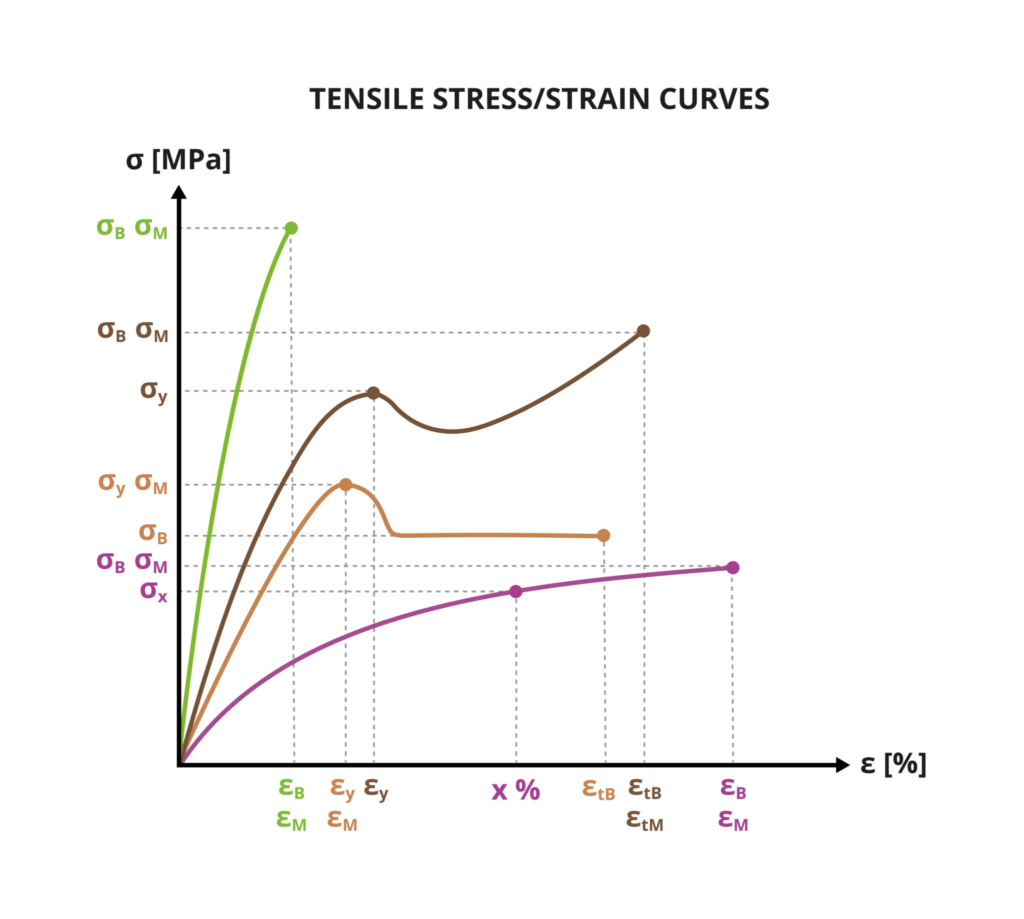
- Heat Treatment Impact: Materials in T6 temper are harder and have higher yield strength (σₛ) than T4 or T5. Expect 15-20% more springback when working with T6 extrusions.
4.Understanding Section Shrinkage (The Poisson Effect)
During the stretch forming process, as the aluminum profile is pulled longitudinally to eliminate springback, a simultaneous contraction occurs in its cross-section. This is known as the Poisson Effect.
- Impact on Assembly: For high-precision curtain walls, a width reduction of 0.5mm to 1.0mm can affect the fitment of glass gaskets, thermal break strips, and snap-on covers.
- Our Advice: If your project has extremely tight tolerances for glass grooves, we recommend accounting for this shrinkage in your initial extrusion design or selecting a tension level that balances springback control with sectional integrity.
These engineering formulas and calculators provide a universal foundation for understanding the mechanics of stretch forming across various industrial sectors. From architectural facades to aerospace components, mastering the interplay between tension, radius, and sectional stability is the key to manufacturing excellence. To gain a deeper understanding of the mechanical principles, tooling configurations, and the different stages of the process, please visit our comprehensive technical guide: Understanding the Stretch Forming Process
Mastering the technical variables of stretch forming—from the theoretical minimum radius to the subtle Poisson effect shrinkage—is essential for the success of any complex architectural project. While these calculators provide a robust foundation for your engineering plans, real-world results also depend on machine precision and the sophisticated control systems used during the bending cycle.
At BIT, our PBF series multi-axis servo stretch forming machines are designed to integrate these calculations into a seamless, automated workflow, ensuring that the physical output perfectly matches your digital designs.