Section Width Shrinkage Calculator for Stretch Forming
The Section Width Shrinkage is a critical dimensional change caused by the Poisson Effect during the longitudinal stretching of a profile.
Predict profile width reduction caused by the Poisson Effect during stretch forming. Calculate final dimensions to ensure glass groove clearance and assembly fitment.
The Section Width Shrinkage is a critical dimensional change caused by the Poisson Effect during the longitudinal stretching of a profile. Our calculator helps engineers predict the precise reduction in width that occurs as the material elongates, ensuring that critical features like glass grooves, interlocks, and mating tolerances remain within specification after the forming process.
For a complete technical assessment, you can also explore our full range of Stretch Forming Engineering Calculators to evaluate other critical factors like Springback and Bending Force.
Section Width Shrinkage Calculator for Stretch Forming
Estimates the reduction in width due to the Poisson Effect during stretching.
Estimated Final Width: 99.34 mm
Curious about the math? View the Engineering Formulas for Width Shrinkage .
Understanding the Poisson Effect in Stretching
When a metal profile is subjected to the high axial tension required for stretch forming, it undergoes longitudinal strain (it gets longer). In accordance with the principles of material mechanics, this axial extension is accompanied by a proportional contraction in the transverse direction—meaning the profile gets slightly narrower and thinner.
While this shrinkage may only be a fraction of a millimeter, it is often enough to cause interference in precision-fit assemblies or make it impossible to insert glass units into pre-machined grooves.
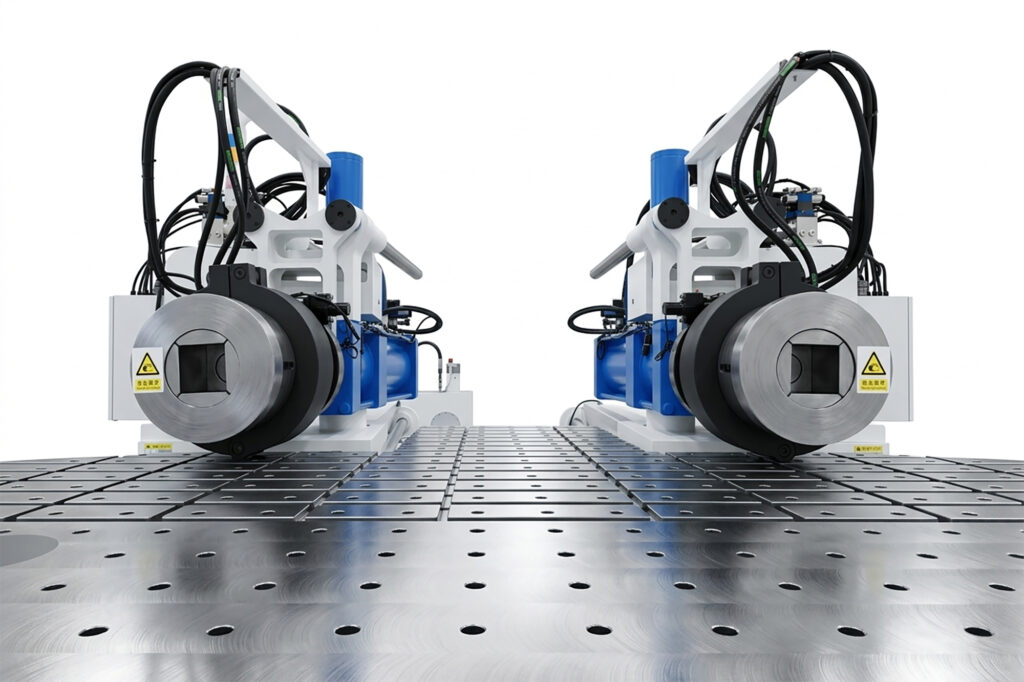
Need to minimize profile cross-sectional deformation and width shrinkage during tight-radius bending? Explore our CNC profile stretch forming equipment, engineered with closed-loop tension control and specialized tooling support to maintain exact geometric tolerances.
 Shrinkage Insight: Section width reduction occurs due to the Poisson effect during axial elongation. Combining optimal pre-tension with flexible internal mandrels or filling materials ensures critical wall dimensions remain well within engineering tolerances.
Why Shrinkage Matters for Production
- Groove Clearance: In curtain wall systems, if the glass groove shrinks too much, the EPDM gaskets or glass units may not fit, leading to costly re-works.
- Assembly Fitment: For profiles designed to slide into one another, even a 0.2mm shrinkage across a long span can compromise the structural integrity or ease of assembly.
- Material Compensation: By predicting shrinkage in the design phase, engineers can slightly over-dimension the raw extrusion dies to compensate for the eventual narrowing.
Poisson’s Ratio Reference Table
| Material Category | Poisson’s Ratio (ν) | Shrinkage Impact |
|---|---|---|
| Aluminum Alloys (6000/7000 Series) | ~0.33 | High (Significant for wide profiles) |
| Stainless Steel (304/316) | ~0.30 | Moderate |
| Structural Steel | ~0.29 | Low to Moderate |
| Titanium Alloys | ~0.34 | Very High (Critical for Aerospace) |
*Note: These are standard theoretical values. Complex hollow extrusions with internal webs may exhibit slightly different localized shrinkage behavior.
Pro Tip: Section shrinkage is rarely perfectly uniform across complex extrusions. Internal webs can act as reinforcements that resist contraction. For high-precision projects, we recommend a “first-article” inspection where the first formed part is measured at multiple points along the curve to verify the actual shrinkage against these theoretical values.
Next Step: Master the Science of Stretch Forming
Understanding sectional changes is just one piece of the puzzle. To achieve perfect curves with zero defects, you need to look at the interaction between tension, position control, and material science. Explore our comprehensive guide on Understanding the Stretch Forming Process to learn how BIT’s servo-controlled technology manages the neutral axis and minimizes distortion for industry-leading precision.