Industrial Multi-Profile Stretch Bending Calculator & Equipment Tonnage Estimator
Accurately estimate the required tensile force to achieve permanent plastic deformation. Engineered for high-precision aluminum extrusions, advanced titanium profiles, and heavy structural sections—including square tubes, round pipes, angle steel, channels, and H-beams—to effectively prevent springback and cross-section distortion.
In the stretch forming industry, the Stretch Bending Force (or Pulling Force) is the most critical parameter for equipment selection. It represents the axial tension required to pull the metal profile into its plastic state, ensuring it conforms perfectly to the die without excessive springback.
Using an undersized machine can lead to incomplete forming, while understanding the precise tonnage required allows for better energy efficiency and longer tool life. For a comprehensive technical assessment, you can also explore our full range of Stretch Forming Engineering Calculators to evaluate other critical factors like R-min and Springback.
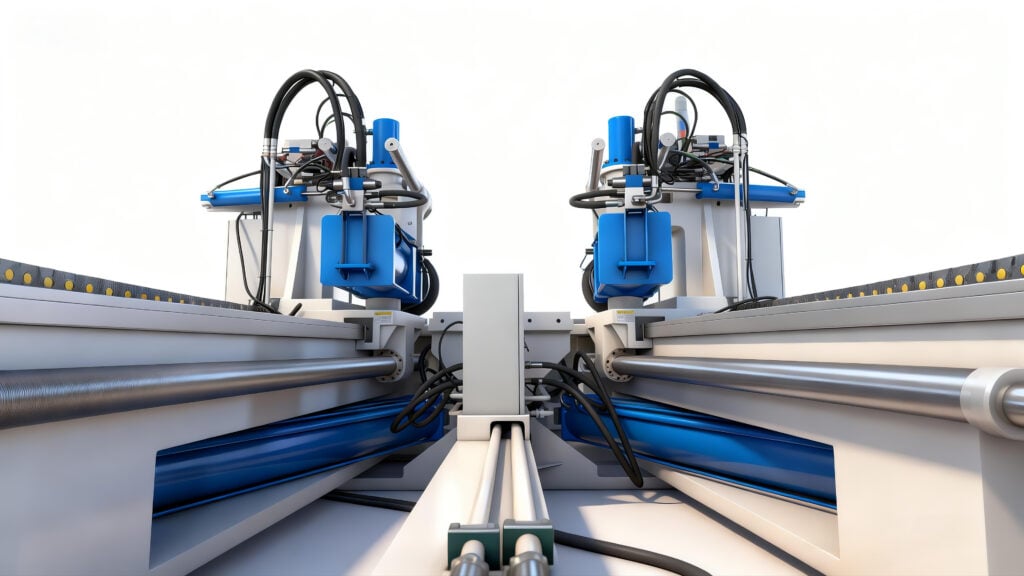
Welcome to the industry’s first Integrated Multi-Profile Stretch Bending Force & Machine Tonnage Online Calculator. In the metal tension forming (Stretch Forming) industry, standard calculators only allow you to input a pre-calculated area. However, in real-world manufacturing, profiles come in complex geometrical shapes such as Square/Rectangular Tubes, Round Pipes, Angle Steels, Channel Steels, and H-Beams.
This comprehensive guide analyzes the stretch bending process characteristics, cross-sectional area formulas, and machine tonnage selection principles for these 5 specific structural profiles.
Stretch Bending Force & Tonnage Calculator
Calculate the required tension to achieve permanent plastic deformation across different profile sections.
Machine Tonnage: 27.5 Metric Tons
(Calculated Area: 1500.0 mm² | k-factor: 1.20)
Need the underlying physics? Check out the Engineering Formulas for Bending Force .
Yield Strength Quick Reference (MPa)
| Alloy & Temper | Typical Yield Strength (σs) | Industry Application |
|---|---|---|
| Aluminum 6063-T4 | 60 – 90 MPa | Max-Deformation Bending, Complex Architectural Profiles |
| Aluminum 6063-T5 | 110 – 145 MPa | Standard Windows, Doors, Mild Curvature Profiles |
| Aluminum 6061-T4 | 110 – 150 MPa | Structural Profiles, Heavy-Duty Stretch Bending (Post-Aged to T6) |
| Aluminum 6061-T5 | 200 – 240 MPa | Medium-High Strength Framing, Controlled Bend Industrial Structures |
| Stainless Steel 304 | 205 – 240 MPa | Decorative, Food Industry |
| Mild Carbon Steel (A36 / Q235) | 235 – 250 MPa | General Infrastructure, Beams, Machinery |
| High-Strength Carbon Steel (A572 / Q355) | 345 – 355 MPa | Bridges, Heavy Structural Profiles, Cranes |
| Titanium Grade 2 (Commercially Pure) | 275 – 450 MPa | Chemical Processing, Marine Piping |
| Titanium Grade 5 (Ti-6Al-4V) | 825 – 920 MPa | Aerospace Structures, High-End Racing |
*Note: These are typical mechanical properties focused on forming and bending feasibility. For critical engineering, always verify with the material test report (MTR).
Once you’ve calculated your required tonnage, select the ideal hydraulic framework for your production demands. Explore our range of heavy-duty CNC stretch forming machines engineered to deliver stable pre-tension and precise bending force across high-strength aluminum and steel profiles.
 Tonnage Insight: Always incorporate a 15–20% safety margin above the calculated peak bending force to accommodate material yield strength fluctuations and ensure optimal hydraulic response during high-tension forming cycles.
Why Do Different Profiles Need Dedicated Calculators?
The core principle of stretch bending is to apply a combined axial tension and bending moment to push the entire cross-section of a metal profile into a state of full plastic deformation. However, different geometric profiles exhibit vast differences in wall thickness distribution, area concentration, and neutral axis positioning:
- If the tensile force is too low, the inner radius of the bend will experience compressive stress, leading to wrinkling and severe springback.
- If the tensile force is too high, areas with thinner walls or smaller cross-sections will experience severe necking or premature tearing.
Therefore, accurately calculating the true cross-sectional area (A) for each specific profile, and multiplying it by the material yield strength (σs) and the process safety coefficient (k), is critical to ensuring a successful bend and protecting machine jaws and dies.
5 Profile Types: Stretch Bending Characteristics & Area Formulas
1. Square / Rectangular Tube Stretch Bending Calculator
Process Characteristics: The primary challenge when stretch-forming square or rectangular tubing is sidewall collapse (concaving) and cross-sectional distortion. Without internal support (like mandrels, flexible cores, or hydraulic pressure), the outer wall thins under tension while the inner wall buckles under compression.
Target Applications: Automotive structural frames, bus body skeletons, and curved rectangular beam components in rail transit.
2. Round Tube / Circular Pipe Stretch Forming Calculator
Process Characteristics: When a round tube is wrapped around a die, its cross-section naturally tends to flatten, resulting in ovalization. Because the cross-section is continuous and perfectly symmetrical, tension must be applied very linearly. It typically requires a higher safety coefficient (k-factor of 1.20 to 1.25) to forcefully override its stubborn springback tendencies.
*Parameters: D = Outer Diameter, t = Wall Thickness
Target Applications: Architectural curved pipe curtains, airport structural steel trusses, and marine curved piping.
3. L-Profile / Angle Steel Stretch Bending Calculator
Process Characteristics: Angle steel represents a classic asymmetric section. Because the neutral axis is completely offset from the geometric center, the profile experiences not only planar bending but also severe twisting (warping) during the process. Standard area calculations frequently make the mistake of double-counting the overlapping corner square.
*Parameters: b1 = Leg 1 Width, b2 = Leg 2 Width, t = Thickness
Target Applications: Asymmetrical structural brackets, aerospace angle profiles, and custom facade trim where twist compensation is critical.
4. Channel Steel / U-Section Stretch Forming Calculator
Process Characteristics: For channel steel, the bending direction (whether the flange opening faces toward or away from the die) dramatically changes the stress mechanics. Furthermore, its flanges and web often have different thicknesses (average leg thickness t vs. web thickness d). Standard calculators completely miss this nuance, leading to under-engineered tonnage estimates.
*Parameters: h = Total Height, b = Flange Width, d = Web Thickness, t = Flange Thickness
Target Applications: Heavy industrial machinery chassis, structural vehicle rails, and heavy-duty engineering construction.
5. H-Beam / I-Beam (IPE / HPE) Stretch Bending Calculator
Process Characteristics: H-beams are heavy-duty structural elements with massive bending resistance. Because the flange plates are located at the extreme outer and inner boundaries of the radius, the outer flange is subjected to immense tensile stress, making it highly susceptible to cracking. Stretching these sections requires immense force, often pushing into hundreds of tons.
*Parameters: H = Total Height, B = Flange Width, t1 = Web Thickness, t2 = Flange Thickness
Target Applications: Large-scale structural steel arches, curved bridge beams, and heavy architectural frameworks.
The Underlying Mechanical Mathematical Engine
When you select a profile from the dropdown menu and input its dimensions, the system executes two standardized mechanical transformations in real-time:
Step 1: Total Required Tensile Force Calculation
By pairing your calculated cross-sectional area (A) with the material yield strength (σs) and your chosen safety coefficient (k-factor), the engine computes the required structural tension:
Step 2: Machine Tonnage Conversion
The kilonewtons (kN) are converted into the stretch bending industry’s universal machine rating indicator, Metric Tons (t), using standard earth gravity:
4. How to Use This Calculator for Machine Selection
- Select Profile Shape: Use the dropdown menu to choose from one of the 5 custom profile shapes (or choose Option 1 to enter a known area directly).
- Enter Dimensions: Look at your engineering drawing and input the exact dimensions in millimeters (mm).
- Input Material Properties: Look up your material’s yield strength (σs) in the reference table below and enter it in MPa (e.g., 240 for Aluminium 6061-T6, 355 for Carbon Steel Q355).
- Set Your k-factor: The calculator defaults to 1.25 (recommended for standard profiles). For high-precision aerospace components or high-strength alloys, select or type a higher custom coefficient.
-
Get Instant Results: Click “Calculate.” The tool will output the exact
Required Force (kN)andMachine Tonnage (Tons). Match this tonnage with market-standard machines (30T, 50T, 100T, or 200T models) to instantly find the right equipment for your job.
💡 Bookmark This Page
This tool seamlessly bridges profile cross-sectional geometry with plastic deformation mechanics, eliminating the guesswork for square tubes, round pipes, angles, channels, and H-beams. Engineering technicians, machine operators, and estimators are encouraged to press Ctrl + D to bookmark this tool for instant access on the shop floor.
Why Calculate the Stretch Bending Force?
- Machine Selection: Determine if a 20-ton, 60-ton, or 100-ton machine is necessary for your specific profiles.
- Process Stability: Ensure the tension is high enough to exceed the material’s yield point but remains safely below its Ultimate Tensile Strength (UTS) to prevent breakage.
- Quality Control: Proper force application minimizes “oil canning” or surface ripples in aerospace and automotive profiles.
Key Factors Influencing the Result
Section Area (A): The Foundation of Material Resistance
The cross-sectional area is the primary physical factor that dictates the total tension requirement. During the stretch forming process, the machine must generate enough axial pull to bring every square millimeter of the profile’s cross-section to its yield point simultaneously. Whether you are forming thick-walled architectural mullions or complex multi-cavity industrial extrusions, a larger total area directly translates to higher resistance. Therefore, for heavy-duty curtain wall systems or structural components in rail transit, engineers must first calculate the precise section area to ensure the selected machine tonnage can overcome this linear increase in force demand.
Yield Strength (σs): The Material’s Mechanical Threshold
Yield strength represents a material’s inherent ability to resist permanent deformation. The disparity in tonnage requirements between different alloys and their temper states can be immense. For instance, the 6000-series aluminum commonly used in architectural projects has a relatively low yield strength, making it easier to form. In contrast, aerospace-grade 7000-series alloys (such as 7075-T6) can possess yield strengths nearly three times higher. This means that even if two profiles have identical geometries, the required tonnage could jump from 20 tons to over 60 tons simply due to the material grade. Understanding these mechanical limits is essential to prevent “under-tonnage” failures where the machine is unable to pull the material into the plastic range.
Tension Mode (k): Overcoming Friction and Locking Geometry
The tension coefficient (k) is a vital engineering correction factor used to compensate for complex losses during the actual forming cycle. As the profile is pulled against the die, internal and external friction occurs. Furthermore, to ensure the part maintains its precise dimensions after being released from the machine, additional force must be applied to shift the “neutral axis” sufficiently, ensuring the entire section enters a state of total plastic deformation. The k-factor (typically ranging from 1.05 to 1.2) ensures that the calculated tonnage not only initiates the bend but also provides the necessary surplus to overcome physical friction and “lock” the final geometric shape into place—a requirement that is particularly critical for high-precision aerospace applications.
Engineering Tip: When your calculated tonnage is near the maximum limit of a specific machine, we always recommend stepping up to the next available capacity. This ensures the hydraulic system operates at an optimal pressure, reducing wear and improving long-term precision.
Explore our [Stretch Bending Machine Series] to find the perfect match for your tonnage requirements.